
ISO 27001 vs ISO 9001: Key Differences Explained
ISO 27001 and ISO 9001 serve different purposes but can complement each other. ISO 27001 focuses on protecting data through an Information Security Management System (ISMS), addressing risks like cyberattacks and breaches. ISO 9001, on the other hand, ensures consistent quality in products and services via a Quality Management System (QMS), prioritizing customer satisfaction.
Here’s a quick breakdown:
- ISO 27001: Best for industries handling sensitive data (e.g., IT, healthcare, finance). Prioritizes confidentiality, integrity, and availability of information.
- ISO 9001: Applicable across industries. Focuses on improving quality and reducing customer complaints.
- Shared Features: Both use the Annex SL framework, enabling easier integration and shared processes like audits and document control.
Quick Comparison:
| Feature | ISO 27001 (ISMS) | ISO 9001 (QMS) |
|---|---|---|
| Objective | Data protection and risk management | Consistent quality and customer satisfaction |
| Target Industries | IT, SaaS, fintech, healthcare | Manufacturing, logistics, services |
| Key Focus | Security risks (e.g., breaches) | Quality risks (e.g., product defects) |
| Documentation | Risk assessments, incident response plans | Quality manuals, customer feedback |
If your focus is data security, go for ISO 27001. If improving product or service quality is your goal, ISO 9001 is the better choice. For businesses needing both, dual certification simplifies processes and boosts credibility.
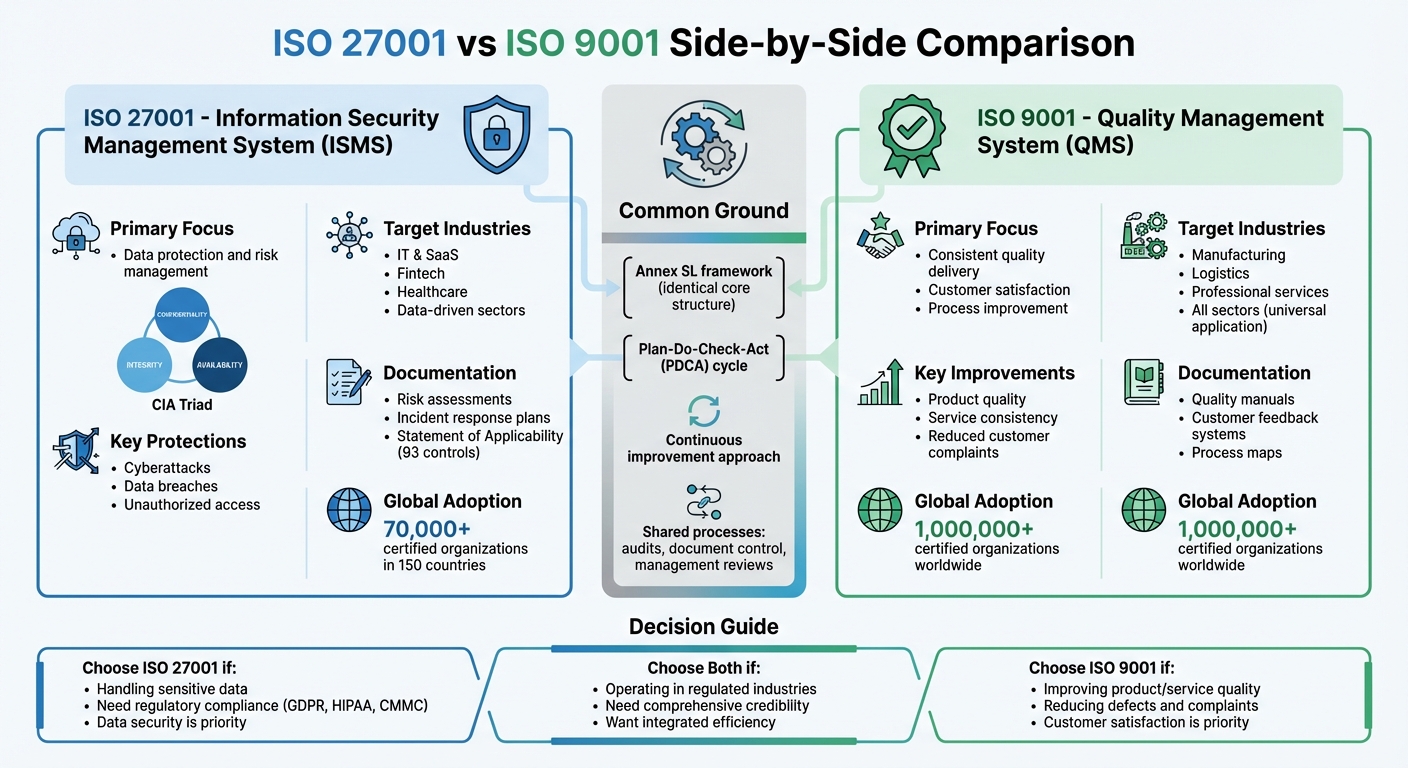
ISO 27001 vs ISO 9001 Comparison Chart
Purpose and Scope: ISO 27001 vs ISO 9001
What is ISO 27001?
ISO 27001 lays out a framework for creating an Information Security Management System (ISMS) to safeguard an organization’s data. At its core is the CIA triad - Confidentiality (ensuring only authorized access to information), Integrity (maintaining data accuracy and completeness), and Availability (making sure authorized users can access data when needed). It addresses a wide range of security risks, including cyberattacks, data breaches, and even risks tied to physical records and employee knowledge.
"An information security management system implemented according to this standard is a tool for risk management, cyber-resilience and operational excellence." – ISO.org
ISO 27001 is particularly relevant for industries where strong data protection is non-negotiable.
What is ISO 9001?
ISO 9001 focuses on building a Quality Management System (QMS) to ensure that products and services consistently meet customer expectations. It applies to every step of the process that impacts quality. The standard is based on seven key principles, including customer focus, fact-based decision-making, and managing relationships effectively.
"ISO 9001 is all about quality management. Its purpose is to help you consistently meet customer requirements, enhance customer satisfaction and business performance." – Perry Simpson, Client Care Advisor, ISO QSL
This standard’s universal approach has made it a global favorite, with over 1,000,000 organizations adopting it across industries like manufacturing, logistics, and professional services. If your business struggles with inconsistent service delivery or frequent customer complaints, ISO 9001 offers a structured way to address these issues. Despite their different goals, both ISO 27001 and ISO 9001 are built on the same Annex SL framework.
Shared Foundations Between Both Standards
While ISO 27001 and ISO 9001 have distinct objectives, they share a common management structure called Annex SL. This framework standardizes key clauses - Context, Leadership, Planning, Support, Operation, Performance Evaluation, and Improvement - making it easier for organizations to implement both systems together. Both standards also rely on the Plan-Do-Check-Act (PDCA) cycle, which promotes continuous improvement and helps streamline monitoring and performance evaluations across the two systems.
| Element | ISO 27001 (ISMS) | ISO 9001 (QMS) |
|---|---|---|
| Primary Goal | Protect information assets and manage security risks | Meet customer requirements and ensure quality |
| Risk Focus | Information security risks (e.g., cyberattacks, data breaches) | Risks affecting quality and performance |
| Target Industries | Data-driven sectors (e.g., SaaS, fintech, healthcare) | All sectors (e.g., manufacturing, logistics, services) |
| Key Output | Reduced security risks and increased data trust | Consistent quality and enhanced performance |
This shared structure allows organizations pursuing both certifications to align processes like document control, internal audits, management reviews, and corrective actions. By doing so, they can reduce overlap and cut down on audit-related expenses.
sbb-itb-b92d866
Main Implementation Differences
How Scope is Defined
The approach to defining scope is a key difference between ISO 27001 and ISO 9001. ISO 27001 focuses on outlining the boundaries of your Information Security Management System (ISMS). This involves identifying which information assets need safeguarding and pinpointing external factors that could pose security risks . For example, you’ll need to specify what data is being protected, where it’s stored, and who has access to it.
On the other hand, ISO 9001 emphasizes the scope of your Quality Management System (QMS). Here, the focus shifts to products, services, and ensuring customer satisfaction . Instead of defining security perimeters, you map out the processes that directly influence quality and the customer experience.
These differences in scope set the foundation for contrasting implementation methods.
Control Requirements
ISO 27001 includes Annex A, which lists 93 specific security controls that organizations must evaluate for relevance . To determine which controls apply, you conduct mandatory risk assessments and document your findings in a Statement of Applicability (SoA) - a requirement unique to ISO 27001.
"ISO 27001 includes Annex A, a list of 93 security controls that you should strive to implement." – Perry Simpson, Client Care Advisor, ISO Quality Services Ltd
In contrast, ISO 9001 takes a more adaptable, process-driven approach. Instead of adhering to a predefined list of controls, you establish measures aligned with your quality objectives and customer needs . This approach prioritizes refining business processes to ensure consistent quality over implementing specific security measures.
The nature of the controls also varies significantly. ISO 27001’s controls delve into technical areas like encryption, network security, and incident response. Meanwhile, ISO 9001 focuses on operational aspects, such as crafting work instructions, evaluating suppliers, and collecting customer feedback.
"Many find ISO 27001 more complex because security controls touch every aspect of the business. ISO 9001 is challenging in its own right but often feels more familiar to organisations already focused on customer satisfaction." – Hicomply
Documentation Requirements
The type and complexity of documentation required by each standard also differ. ISO 27001 demands technical documents like the Statement of Applicability, Information Security Policy, Risk Treatment Plans, and Incident Response Procedures. These documents are tailored to managing security risks and often require specialized expertise.
ISO 9001, on the other hand, focuses its documentation on ensuring process consistency and meeting customer expectations. Typical documents include a Quality Manual, Quality Policy, Process Maps, and systems for gathering customer feedback.
While both standards share a common structure under Annex SL - facilitating integration of elements like document control and internal audits - the content of their documentation is quite distinct .
| Documentation Category | ISO 27001 (Security) | ISO 9001 (Quality) |
|---|---|---|
| Core Policy | Information Security Policy | Quality Policy & Objectives |
| Primary Framework | Statement of Applicability (SoA) | Quality Manual |
| Risk Management | Risk Assessment & Treatment Plans | Process Risk Identification |
| Operational Records | Security Incident Reports, Access Logs | Quality Records, Corrective Action Reports |
| Technical Plans | Backup & Disaster Recovery Plans | Work Instructions & Process Maps |
For organizations implementing both standards, it’s possible to streamline efforts by focusing on shared elements like document control, leadership commitment, and corrective actions. Combining these overlapping requirements can help reduce redundancy and make managing both systems more efficient.
Benefits of Using ISO 27001 and ISO 9001 Together
Combined Benefits and Efficiencies
Combining ISO 27001 and ISO 9001 into an Integrated Management System (IMS) can simplify operations and improve overall performance. Instead of juggling separate systems for quality and security, you can merge key processes like document control, internal audits, management reviews, and corrective actions into a unified framework.
"An integrated management system (IMS) combines multiple management systems into a single cohesive framework. This integration allows your organisation to manage various functions and processes to enhance efficiency." – NQA
This unified approach allows for shared risk management, enabling you to evaluate both quality and security risks together. By doing so, you can uncover how quality issues might also lead to security vulnerabilities. For example, poor supplier quality controls could potentially open the door to data security risks.
Another advantage is conducting combined audits. These save time, reduce disruption, and cut costs by assessing both standards in one session. Employees trained in both standards can also better understand the interplay between quality and security, creating a more cohesive and informed workforce.
Holding both certifications can give your organization a competitive edge. As of 2022, more than 1,000,000 companies worldwide are certified to ISO 9001, while over 70,000 hold ISO 27001 certifications across 150 countries. Achieving dual certification signals to customers that you’re committed to delivering high-quality products while safeguarding their sensitive information.
These benefits translate into real-world efficiencies across industries.
Real Example of Integration
The information technology sector is a standout example of how integration works in practice. According to the 2021 ISO Survey, IT companies account for nearly 20% of all ISO 27001 certificates globally, and many of these organizations are also ISO 9001 certified. These companies integrate security measures directly into quality-driven software development processes.
For instance, a software development company with both certifications might create procedures that incorporate secure coding practices (ISO 27001) into their standard quality control measures (ISO 9001). This ensures developers follow a unified set of instructions, addressing both code quality and security vulnerabilities at the same time.
In healthcare, integration is evident in how patient records are managed. A single policy framework can govern the collection, storage, and access of sensitive patient data, ensuring compliance with both standards. This eliminates redundant documentation and prevents conflicting procedures, all while maintaining high standards of care.
Manufacturing companies also gain from this approach. By embedding intellectual property protection into their quality control processes, they can safeguard proprietary designs while ensuring consistent product quality. Instead of separate teams handling quality and data security, integrated systems streamline workflows and protect sensitive information throughout production.
This alignment across industries highlights the value of combining these standards into a cohesive system.
How to Choose the Right Standard
When to Choose ISO 9001
Opt for ISO 9001 if your primary goal is to ensure consistent delivery of products or services while meeting customer expectations. This standard is particularly useful for proving service quality and streamlining processes to support long-term growth.
Industries like manufacturing, logistics, and service-based businesses often gain the most from ISO 9001. If you're aiming for government contracts or working with major corporate clients, this certification is often a prerequisite. Many government projects and high-value corporate deals require proof of consistent quality management before considering your bid.
"ISO 9001 strengthens your ability to deliver a consistent product and improve customer satisfaction. ISO 27001 strengthens your ability to protect data security and meet regulatory requirements." – Hicomply
ISO 9001 is applicable across various industries, making it the go-to choice when your focus is on improving operational efficiency and enhancing customer satisfaction - not on data security.
If your challenges lean more toward data sensitivity and regulatory compliance, ISO 27001 might be the better fit.
When to Choose ISO 27001
ISO 27001 is ideal if your business handles sensitive data such as personal information, financial records, or intellectual property. This standard is particularly relevant for SaaS providers, fintech companies, healthcare organizations, and IT service firms.
Compliance with regulations like GDPR, HIPAA, NIST SP 800-171, or CMMC often necessitates ISO 27001 certification, as it provides a structured approach to managing data security risks. Increasingly, clients and partners require this certification to ensure their data is managed securely.
"Conformity with ISO/IEC 27001 means that an organization or business has put in place a system to manage risks related to the security of data owned or handled by the company." – ISO
Interestingly, nearly 20% of ISO 27001 certifications are held by IT companies, underscoring its importance in data-driven industries. If your business relies on earning and maintaining customer trust in your data security practices, this standard should be a top priority.
When to Implement Both Standards
For businesses that need to address both quality assurance and data protection, pursuing dual certification can be highly advantageous. This is particularly true in regulated sectors - such as healthcare, finance, and SaaS - where reliability and data security are equally critical.
From a financial perspective, implementing both standards simultaneously can be cost-effective. Certification bodies often provide discounts for organizations pursuing multiple certifications at once. Additionally, you can reduce consultancy fees and streamline efforts by tackling shared elements - like document control, internal audits, and management reviews - only once rather than duplicating the work.
If you’re considering dual certification, it’s more efficient to implement both standards together rather than adding one later. Thanks to the shared Annex SL framework, both standards have identical core structures, making integration straightforward from the beginning. This approach helps eliminate redundant processes and promotes a unified culture where quality and data security are equally prioritized.
Globally, over 1,000,000 companies are certified to ISO 9001, while more than 70,000 organizations hold ISO 27001 certifications across 150 countries. Achieving dual certification demonstrates your organization’s commitment to both quality and security, significantly boosting its credibility in the marketplace.
ISO 9001 vs ISO 27001 Explained | Differences Between ISO 9001 vs ISO 27001 | The Knowledge Academy
Conclusion
While ISO 9001 and ISO 27001 serve distinct purposes, they work well together to enhance an organization’s overall performance. ISO 9001 emphasizes quality management and customer satisfaction, ensuring consistent delivery of products and services across industries. On the other hand, ISO 27001 is all about safeguarding information, focusing on the principles of Confidentiality, Integrity, and Availability (CIA).
What makes these standards easier to integrate is their shared foundation: the Annex SL framework. This common structure simplifies leadership oversight, document management, and audit processes, making dual certification a practical choice. By achieving both certifications, organizations can improve efficiency and boost their credibility in the market.
For industries that deal with sensitive data - like IT, finance, healthcare, or SaaS - ISO 27001 certification signals a strong commitment to protecting data and meeting regulatory demands. If information security is your priority, ISMS Directory offers tailored support to guide you through the ISO 27001 certification process. From compliance tools and consulting services to training and auditing, their resources are designed to meet your unique needs.
Whether you pursue one certification or both, the goal should always align with your business priorities. Combining quality management with robust information security not only strengthens your organization’s resilience but also builds customer trust and solidifies your market position.
FAQs
What are the advantages of combining ISO 27001 and ISO 9001?
Combining ISO 27001 (focused on information security) and ISO 9001 (centered on quality management) can offer a range of advantages for your organization. Since both standards share a common high-level structure, integrating them allows you to streamline management processes. This means less duplication of tasks, saving valuable time and resources while maintaining compliance with both frameworks at the same time.
Beyond efficiency, this integration strengthens operations by aligning quality management systems with information security protocols. This alignment not only enhances internal processes but also builds trust and confidence among clients and stakeholders. Moreover, it creates a unified approach to risk management and encourages ongoing improvements, making your organization more efficient and resilient in the face of challenges.
How does the Annex SL framework simplify achieving both ISO 9001 and ISO 27001 certifications?
The Annex SL framework makes obtaining dual certification simpler by offering a unified structure for ISO management system standards, such as ISO 9001 and ISO 27001. It standardizes key components like clauses, terminology, and core requirements, allowing organizations to merge both standards into one cohesive management system.
By adopting Annex SL, businesses can simplify their workflows, cut down on redundant efforts, and align their documentation. This integrated approach not only saves resources but also promotes consistency between quality and information security management, helping organizations meet the requirements of both standards more effectively.
What types of industries benefit the most from ISO 27001 certification?
Industries that deal with sensitive or confidential information gain the most from ISO 27001 certification. This certification not only strengthens information security practices but also builds confidence among stakeholders. Key industries include:
- Finance: Protecting financial data is critical. ISO 27001 helps ensure regulatory compliance and fosters trust with clients.
- Healthcare: Patient data is safeguarded, and risks tied to third-party providers are effectively managed.
- Legal: Secure handling of documents and maintaining client confidentiality are prioritized.
- Technology and SaaS: Certification meets enterprise vendor requirements and reassures customers about data security.
- Manufacturing: It facilitates secure global trade and reinforces supply chain security.
By implementing ISO 27001, organizations in these sectors can strengthen their security measures, demonstrate adherence to standards, and effectively manage critical data while staying competitive.