

How Much Does ISO 27001 Certification Cost in 2026?
ISO 27001 certification costs in 2026 depend on your organization's size, complexity, and approach. Here's a quick breakdown:
-
Certification Body Fees:
- Small businesses (1–10 employees): ~$7,800
- Mid-sized companies (86–125 employees): ~$19,000
- Large organizations (276–425 employees): $30,000+
-
Internal & External Audits:
- Internal audits: $5,000–$15,000
- Gap analysis: $2,000–$10,000
- External audit day rate: $1,000–$1,500
-
Consultancy & Training:
- Consultants: ~$1,500/day
- Training: $3,200 per person for lead implementers/auditors
- Security awareness training: $50–$100 per employee
-
Annual Maintenance:
- Surveillance audits: $6,000–$7,500/year
- Recertification (every 3 years): $14,000–$30,000
First-year costs range from $10,000 to $60,000, depending on your size and method. Tools like ISMS Copilot can reduce manual work by 80%, potentially saving up to $60,000.
Certification is more expensive in 2026 due to a 20% rise in auditor fees caused by a shortage of professionals. Planning and using automation tools can help manage costs effectively.
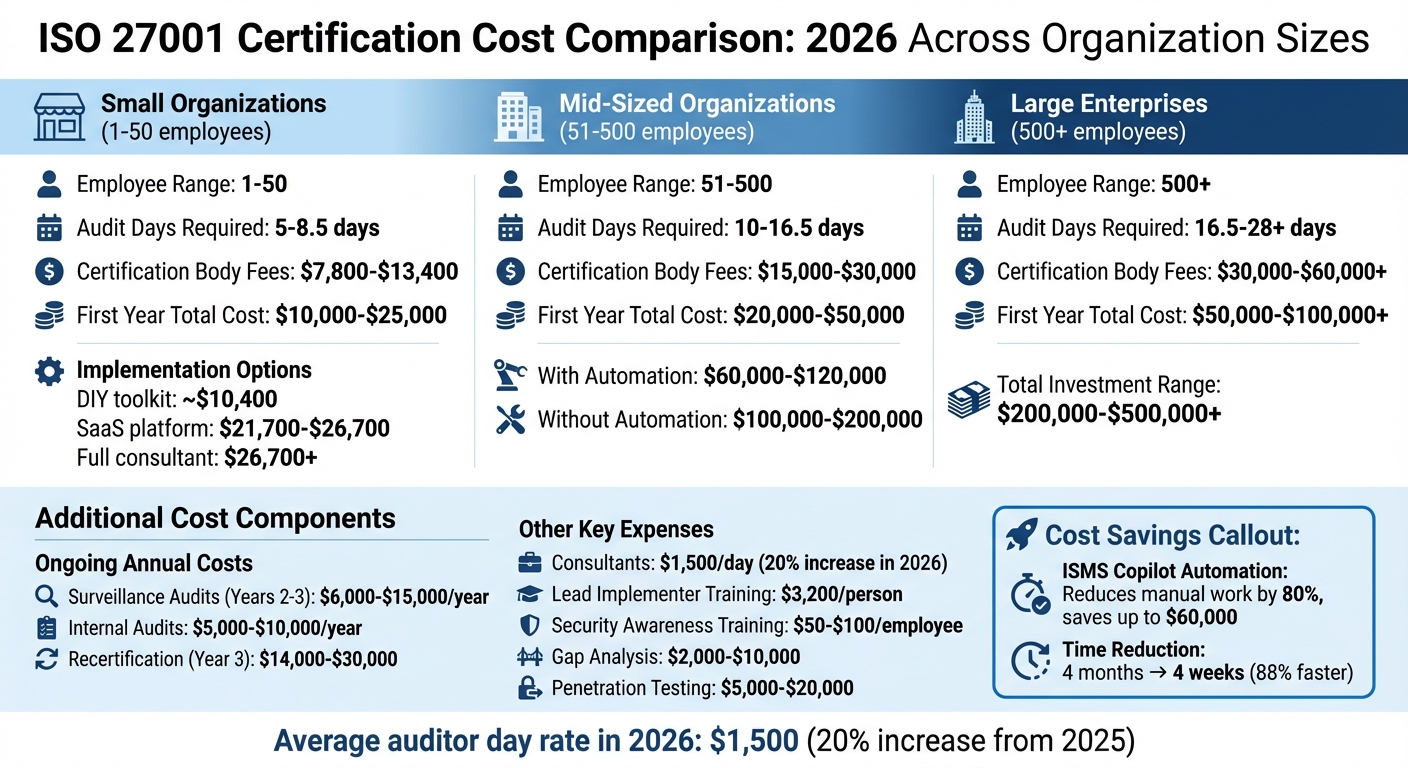
ISO 27001 Certification Costs by Organization Size in 2026
ISO 27001 Certification Costs Explained Simply | The Lead Auditor Podcast
Main Cost Components of ISO 27001 Certification
Planning your budget effectively can help you avoid unexpected costs. The key expenses to account for include certification body fees, audit costs (both internal and external), as well as consultancy and training expenses. Here's a breakdown of these components to help you allocate resources wisely.
Certification Body Fees
Certification bodies determine their charges based on the number of audit days required. Factors like your employee count, number of locations, operational complexity, and risk profile all play a role in this calculation. These fees typically cover audit planning, on-site or remote audits, report preparation, and certificate issuance.
For example:
- Small businesses (1–10 employees): Expect to pay around $7,800 for 5 audit days.
- Mid-sized companies (86–125 employees): Costs can reach approximately $19,000 for 12 audit days.
- Larger organizations (276–425 employees): Fees may climb to $30,000 or more for 15+ audit days.
After the initial certification, you'll also need to budget for annual surveillance audits, which cost between $6,000 and $7,500. Every three years, a full recertification audit is required, with expenses ranging from $14,000 to $30,000.
"Choosing a single provider for both audit phases can reduce administrative overhead and offer pricing discounts - especially for small-to-mid-size organizations."
– Nojus Bendoraitis, General Counsel, Copla
To ensure international recognition, always verify that your certification body is accredited by an authority like ANAB. Bundling Stage 1 and Stage 2 audits with the same provider can also streamline the process and lower costs.
Internal and External Audit Costs
Before the official certification audit, an internal audit is essential to identify gaps in your Information Security Management System (ISMS). You can conduct this internally or hire consultants, with costs ranging from $5,000 to $15,000, depending on the complexity. Internal audits typically require between 24 and 160 hours of work. A gap analysis, often performed before the internal audit, costs between $2,000 and $10,000, with mid-sized cloud-hosted companies averaging around $5,700. While these upfront costs may seem high, they are critical to achieving certification on the first attempt and avoiding costly corrective audits.
The external certification audit, conducted by your chosen certification body, involves lead auditors who charge between $1,000 and $1,500 per audit day.
"If you only budget for the audit, you will run out of money before the auditor even arrives. Implementation is where 80% of the operational spend occurs."
– Stuart Barker, Lead Auditor
Consultancy and Training Expenses
Consultants typically charge a day rate of $1,500, and fees have risen by 20% in recent years due to a shortage of accredited auditors. If your organization lacks in-house expertise, you'll also need to account for costs related to gap analyses, risk assessments, and documentation.
Training costs are divided into two categories:
- Professional certification: Lead implementer or auditor training costs about $3,200 per person.
- Security awareness training: Annual mandatory training for employees ranges from $50 to $100 per person [1,9].
Since human error contributes to up to 90% of security breaches, investing in workforce training is non-negotiable.
For smaller organizations, DIY toolkits with pre-written templates can be a budget-friendly option, costing around $500 to $1,000. These kits can save over $10,000 compared to hiring full-service consultants. Additionally, compliance automation platforms can reduce manual consulting hours by up to 80%, potentially saving as much as $60,000 in consulting fees. Depending on your organization's size and needs, these tools can make a significant difference in cost management.
What Affects ISO 27001 Certification Costs
When planning for ISO 27001 certification, it's important to understand the factors that shape the overall cost. Three key elements play a role: the size of your organization, the complexity of your Information Security Management System (ISMS), and your geographic location. Let’s take a closer look at how each of these impacts the total expense.
Organization Size and Employee Count
The number of employees in your organization directly affects how many audit days are required. Certification bodies adhere to the ISO/IEC 27006-1:2024 standard, which sets audit day requirements based on workforce size. More employees mean more audit days, which naturally increases costs.
For instance, certification bodies charge per audit day, with the average rate in 2026 being $1,500 per day. A small company with 1–10 employees typically needs around 5 audit days, costing about $7,800. Mid-sized organizations with 86–125 employees usually require 12 audit days, raising expenses to approximately $19,000. Large enterprises with 8,500+ employees may need 27 or more audit days, significantly increasing costs.
"In 2026, U.S. certification bodies charge an average of $1,500 per auditor day, reflecting a 20% increase over 2025 rates due to a shortage of accredited auditors."
– Stuart Barker, ISO 27001 Lead Auditor
If your organization operates across multiple locations, you might be able to rotate audit visits during the three-year certification cycle. This approach can help lower annual costs, provided operations remain consistent across sites.
Scope and Complexity of the ISMS
The scope of your ISMS has a big impact on both preparation expenses and the length of the audit. A more focused scope - such as targeting specific services or departments - can reduce the required audit days and simplify documentation.
For organizations starting from scratch, preparation costs can range between $10,000 and $60,000. This includes creating policies, conducting risk assessments, and drafting a Statement of Applicability (SoA)[1,5]. The complexity of your IT environment also plays a role. Managing multiple platforms, networks, or third-party relationships requires more auditor time, which increases costs.
"Clearly defining boundaries for in-scope versus out-of-scope assets can reduce preparation workload and auditor time."
– Stuart Barker, ISO 27001 Lead Auditor
Geographic Location and Certification Body
Where your organization is located and the certification body you select can cause costs to vary significantly. Local market conditions and travel requirements influence audit rates. If the certification body is far from your location, travel expenses for auditors - such as lodging and meals - can add up. To save on these costs, check if the certification body offers remote or hybrid audits.
The reputation of the certification body also matters. Well-known firms like PwC, Deloitte, EY, and KPMG often charge higher rates due to their brand recognition. However, smaller accredited firms may provide the same certification services at a lower price. Always verify that the certification body is accredited by a recognized authority like ANAB. While non-accredited organizations might offer cheaper rates, their certifications often lack global acceptance.
To get the best value, request quotes from at least three accredited certification bodies and compare their daily rates and administrative fees. Small- and mid-sized organizations might also negotiate better rates by bundling Stage 1 and Stage 2 audits with the same provider. This careful selection process can help you manage costs effectively as you move forward with certification.
Tools and Platforms That Reduce Certification Costs
Cutting the costs and time involved in ISO 27001 certification is now more achievable thanks to advancements in technology. In 2026, many organizations are adopting AI-driven platforms and service directories to sidestep the hefty expenses tied to traditional consulting and manual processes. Two key tools making waves in this space are ISMS Copilot and the ISMS Directory, which tackle major cost drivers like documentation and sourcing affordable service providers.
ISMS Copilot for Faster Implementation
ISMS Copilot leverages artificial intelligence to handle the most tedious parts of ISO 27001 compliance. Tasks like drafting ISMS documentation, the Statement of Applicability (SoA), and risk assessments - normally requiring months of manual effort - are automated. This can slash your compliance workload by as much as 80%, potentially saving up to $60,000 in consulting and implementation costs. It even replaces the need for expensive external gap analyses.
The platform doesn’t just stop at documentation. It pinpoints compliance gaps in real time, helping you address issues before the audit. This efficiency can shrink the readiness phase from four months to just four weeks - a staggering 88% reduction in preparation time.
ISMS Copilot also syncs seamlessly with tools you already use, like AWS, Azure, Slack, and Teams. Evidence collection becomes a breeze with chatbot-driven workflows, eliminating the need for manual organization. A continuous monitoring dashboard ensures you're always audit-ready, with automated alerts highlighting any compliance gaps. With these features, organizations using AI-powered platforms like ISMS Copilot can achieve ISO 27001 compliance up to 90% faster compared to those relying on manual methods.
While ISMS Copilot transforms internal processes, the ISMS Directory takes care of finding the right external expertise.
ISMS Directory for Finding Service Providers
To complement the internal efficiencies offered by ISMS Copilot, the ISMS Directory simplifies the search for affordable, qualified service providers. This platform connects you with verified experts in all areas of ISO 27001 certification, helping you avoid the steep daily rates of $1,400 to $1,800 charged by specialized consultants.
The ISMS Directory goes beyond just listing providers - it includes reviews and pricing comparisons to help you identify cost-effective options. It also allows you to filter for providers offering bundled Stage 1 and Stage 2 audits. For industries with higher compliance risks, like fintech, you can search for consultants with relevant expertise who also use automation tools to reduce manual work. This feature is particularly helpful given the 20% rise in auditor fees in 2026, driven by a shortage of auditors.
sbb-itb-b92d866
Cost Estimates by Organization Size
Understanding how organization size influences ISO 27001 certification costs is crucial for effective budgeting. Employee count plays a significant role, as the ISO 27006 standard sets minimum audit day requirements based on headcount. These audit days directly impact certification body fees and, consequently, overall expenses.
Small Organizations (1–50 Employees)
For small businesses, certification typically requires 5 to 8.5 audit days [7,9]. External audit fees vary depending on company size. For instance:
- 1–10 employees: Roughly $7,800 to $10,000
- 26–45 employees: Around $13,400 [7,9]
First-year costs depend on the implementation approach. Here's an overview:
- DIY toolkit: Approximately $10,400
- SaaS compliance platform: Between $21,700 and $26,700
- Full-service consultant: $26,700 or more
The readiness phase, which includes gap analysis, documentation, and internal audits, can range from $10,000 to $39,000.
"In 2026, U.S. certification bodies charge an average of $1,500 per auditor day. For small organizations (1-10 staff), when you factor in mandatory internal audits and documentation preparation, the total Year 1 core compliance cost starts at approximately $10,800."
– Stuart Barker, ISO 27001 Lead Auditor, High Table
Mid-Sized Organizations (51–500 Employees)
Mid-sized companies face steeper costs due to increased audit requirements, which typically range from 10 to 16.5 days. Certification body fees for this group fall between $15,000 and $30,000 [9,23]. Total first-year costs are estimated at $100,000 to $200,000, with internal labor adding $40,000–$80,000. However, automation can help reduce expenses to $60,000–$120,000. Surveillance audits, conducted annually, cost between $6,000 and $12,000.
Large Enterprises (500+ Employees)
For large organizations, ISO 27001 certification becomes even more complex and expensive. Audit requirements typically range from 16.5 to 28 days or more. Certification body fees start at $30,000 and can exceed $60,000 [9,23]. Specific examples include:
- A few thousand employees: External audit fees of approximately $37,000
- Close to 10,000 employees: Fees around $46,400
The total first-year investment can range from $200,000 to over $500,000. Internal labor costs are significant, estimated at $80,000 to $160,000 or more. Hiring a dedicated compliance professional adds about $90,000 annually [1,23]. Additional costs, such as penetration testing ($5,000 to $20,000), further impact the budget. Recertification every three years requires the full initial certification fee, while annual surveillance audits cost about one-third of that amount.
These estimates highlight the importance of tailoring your budget to your organization’s size and needs, ensuring all cost factors are accounted for.
First-Year Costs vs. Annual Maintenance Costs
Breaking down the costs of ISO 27001 certification over its three-year cycle is crucial for proper financial planning. The first year is where you'll encounter the highest expenses, as this is when you establish your ISMS. This includes tasks like conducting gap analyses, drafting policy documents, implementing controls, and completing certification audits. These initial efforts typically cost between $10,000 and $60,000 [5,1]. It's a hefty upfront investment, but the costs taper off significantly in the following years.
Once certified, the focus shifts to maintenance during Years 2 and 3. Instead of undergoing a full audit, you'll have annual surveillance audits, which cost about one-third of the initial certification fee - approximately $6,000 to $7,500 per year for small to mid-sized organizations. On top of that, you’ll need to budget for internal audits, which range from $5,000 to $10,000 annually.
"The cost of a surveillance audit is typically about a third of the cost of your initial certification audit. This is a mandatory requirement, and if you fail to complete it, your certificate will be revoked." – Stuart Barker, ISO 27001 Lead Auditor
In Year 3, costs rise again due to the need for a full recertification audit, which is a comprehensive review of your ISMS. This can cost 80% to 100% of your original certification fee, amounting to anywhere between $14,000 and $30,000, depending on your organization's size. Many organizations overlook this expense, so it's critical to plan your Year 3 budget with the same attention as Year 1.
Another factor to consider is the time investment. Manual ISMS management can take up 550–600 hours annually, but using automation tools can reduce this to about 75 hours. This time savings can significantly impact your overall costs and efficiency.
Conclusion
The costs of ISO 27001 certification in 2026 vary widely, influenced by factors like organization size, the scope of certification, and the chosen implementation strategy. For the first year, small organizations can expect to spend between $10,000 and $25,000, mid-sized companies typically face $20,000 to $50,000, and large enterprises may invest upwards of $50,000–$100,000. These estimates generally include certification body fees, internal audits, and implementation efforts. Additionally, annual surveillance audits cost around $6,000 to $15,000.
Key cost factors include the size of the organization, which determines the number of mandated audit days, and the implementation method. Traditional consulting services can range from $20,000 to over $60,000, while DIY approaches, though seemingly cost-effective, often demand significant internal resources - potentially exceeding $39,000 in productivity losses. A hybrid approach using automation tools like ISMS Copilot can reduce manual effort by 80% and speed up compliance by 90%, offering potential savings of up to $60,000 on implementation costs.
"ISO 27001 converts scattered security tasks into one operating system for risk, giving leaders traceable decisions, measurable controls and audit-ready evidence."
- Alina Ansari, Author
It's essential to budget beyond the first year, considering costs over a three-year certification cycle. While Year 1 carries the largest expenses, annual surveillance audits and recertification in Year 3 - typically costing 80% to 100% of the original fee - must also be accounted for. Rising auditor fees, driven by market shortages, further emphasize the need for careful financial planning.
Tools like ISMS Directory simplify the certification process by connecting organizations with vetted certification bodies, consultants, and training providers. Comparing multiple quotes ensures you find the best fit for your budget and needs. When paired with ISMS Copilot, this approach transforms ISO 27001 certification from a costly obligation into a manageable investment. It not only streamlines compliance but also strengthens security practices, protecting your business from the average $4.88 million cost of a data breach. These tools make achieving certification both efficient and impactful for long-term success.
FAQs
How can tools like ISMS Copilot help lower the cost of ISO 27001 certification?
Tools like ISMS Copilot can help lower the costs of achieving ISO 27001 certification by automating essential compliance tasks. This includes tasks like gathering evidence, managing risks, and getting ready for audits, which reduces the need for manual effort and trims labor-related expenses.
By simplifying intricate processes and boosting efficiency, ISMS Copilot not only saves valuable time but also helps organizations steer clear of expensive errors, making the certification process much smoother.
What should small businesses keep in mind when planning the cost of ISO 27001 certification?
When budgeting for ISO 27001 certification, small businesses need to weigh several important factors. One of the biggest considerations is the size of the organization. For smaller companies, such as those with 1–10 employees, certification fees tend to be more affordable. In 2026, total costs - including certification audits, internal audits, and necessary documentation - are estimated to range between $8,000 and $10,000 for small businesses.
Another key factor is the scope of your Information Security Management System (ISMS). If your business processes are broad or particularly complex, you may need additional support, such as hiring external consultants, which can drive up expenses. Your geographic location also matters, as certification fees and the availability of auditors can vary depending on the region.
To simplify the process and potentially cut costs, tools like ISMS Copilot can be a game-changer. They automate tasks like evidence collection and risk management, saving both time and effort. By taking these elements into account, small businesses can develop a practical budget that aligns with their goals and available resources.
How does the size of an organization affect ISO 27001 certification costs?
The size of your organization significantly influences the cost of ISO 27001 certification. For smaller organizations, the process generally requires fewer audit days - usually between 3 and 6 - with total expenses falling between $5,000 and $10,000.
Larger organizations face higher costs, often exceeding $40,000, due to their more complex systems and broader scopes. These require longer audits, more extensive preparation, and ongoing efforts to maintain compliance.
Understanding how size impacts these costs can help businesses plan effectively and allocate the necessary resources for certification.