
ISO 27001 Certification Bodies: How to Choose One
When selecting an ISO 27001 certification body, the key is ensuring they are accredited, experienced in your industry, and reputable. Accreditation guarantees global recognition for your certificate, while experienced auditors provide assessments tailored to your business needs. Avoid non-accredited bodies, as their certificates may be rejected, leading to wasted time and money. Here’s how to make the right choice:
- Verify Accreditation: Check for accreditation from recognized bodies like ANAB or UKAS. Use directories like IAF CertSearch or ANAB’s CB directory to confirm credentials.
- Assess Industry Expertise: Ensure auditors understand the unique challenges of your sector. Request CVs and references to verify their experience.
- Check Reputation: Look for client testimonials, industry reviews, and case studies. Avoid bodies known for superficial audits.
- Evaluate Costs: Compare total costs, including audits, travel, and surveillance fees. Avoid low-cost providers that may compromise quality.
Using tools like the ISMS Directory can simplify finding accredited certification bodies with regional support and relevant expertise. Always request proposals from multiple providers to compare their qualifications and services.
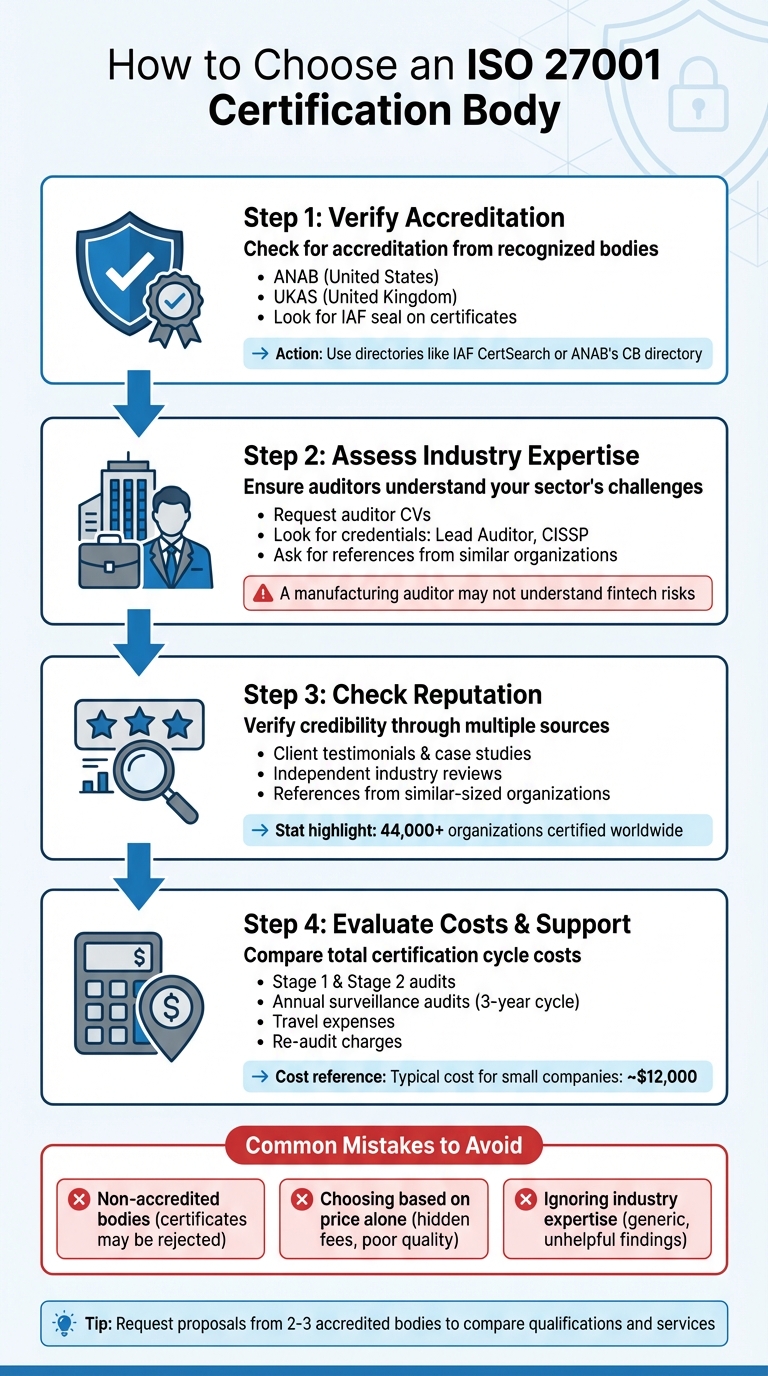
4-Step Process to Choose an ISO 27001 Certification Body
What Is Accreditation and Why It Matters
Definition of Accreditation
Accreditation is the process where an independent authority evaluates a certification body to ensure it meets international standards for competence, impartiality, and audit practices. When it comes to ISO 27001, accreditation confirms that the certification body is qualified to audit and certify your Information Security Management System in line with ISO/IEC 17021-1 and ISO/IEC 27006 standards.
This process serves as an independent check on a certification body’s ability to operate fairly and effectively. The International Accreditation Forum (IAF) oversees national accreditation bodies globally, ensuring they adhere to consistent standards. If you work with an accredited certification body, your ISO 27001 certificate will often carry the IAF seal, signaling global acceptance. To maintain their status, accredited bodies undergo annual audits - both in-office and on-site.
"ANAB accreditation of certification bodies (CBs) ensures impartiality and competence, and fosters confidence and acceptance of an organization's accredited certification by their customers and end users in public and private sectors." - ANAB
Main Accreditation Bodies in the United States
In the U.S., the ANSI National Accreditation Board (ANAB) is the leading authority for accrediting management systems, including ISO 27001. ANAB holds the distinction of being the first management systems accreditation body established in the country and was a founding member of the IAF. It issued its first ISO 9001 accreditation in 1991 and its first ISO 14001 accreditation in 1997.
Another notable accreditation body is the United Kingdom Accreditation Service (UKAS). Though based in the UK, it operates under IAF agreements and is recognized throughout the European Union. Both ANAB and UKAS are signatories to the IAF Multilateral Recognition Arrangement, which ensures globally recognized certifications. This mutual recognition eliminates the need for multiple audits when businesses operate in different regions.
With trusted organizations like ANAB upholding global standards, the next step is verifying the credentials of individual certification bodies.
How to Check a Certification Body's Accreditation
To confirm a certification body’s accreditation and the validity of its certificates, start by consulting the ANAB Management Systems CB Directory. This resource provides contact details and links to the accreditation certificates of recognized certification bodies.
When reviewing a certificate, look for the ANAB symbol, the IAF mark, and complete identification details to ensure international recognition. The certificate should include the certification body’s name, the version of the standard (e.g., ISO/IEC 27001:2022), a unique ID, and a scope that accurately reflects your organization’s products or services. Official directories can help you verify these details. Certification bodies, as required by ISO/IEC 17021-1, must provide information about a certification's status upon request.
Before finalizing any agreements, always verify credentials through official directories. Using an unaccredited body could lead to stakeholders rejecting your certificate, potentially leading to expensive re-audits.
Top 10 ISO 27001 Companies and Top 10 ISO 27001 Certification Bodies 2026 Podcast
What to Look for When Choosing a Certification Body
After confirming a certification body’s accreditation, the next step is determining if they’re the right fit for your organization. This decision involves more than just credentials - it requires evaluating their industry expertise, track record with similar clients, and whether their pricing and support structure aligns with your needs.
Industry Experience and Auditor Credentials
Industry knowledge matters. A certification body experienced in manufacturing might not fully understand the unique challenges of a fintech startup or healthcare provider. Every industry has its own regulatory requirements and risks, so it’s crucial to work with auditors who understand your field.
"If you are a bank, it is actually not a very good idea to have a certification body that has previously certified only manufacturing companies." - Carlos Pereira da Cruz, Consultant and Auditor
When assessing a certification body, ask for the auditors’ CVs. Look for credentials like Lead Auditor or CISSP (Certified Information Systems Security Professional). More importantly, ensure they’ve worked with organizations in your sector. For example, if you operate in a cloud-native or DevOps environment, the auditors should be familiar with automated controls and modern technologies.
In the U.S., firms like A-LIGN and Schellman are well-regarded for auditing SaaS and tech companies. Choosing a certification body with relevant experience reduces the need to explain your business processes and ensures the audit findings are actionable.
Reputation and Client Feedback
A certification body’s reputation can reveal whether they conduct thorough audits or simply issue certificates without proper scrutiny. Your stakeholders - whether clients, partners, or regulators - will evaluate your ISO 27001 certificate based on the credibility of the issuing body.
"If you want to use your certificate for marketing purposes, you probably don't want to get the certificate from a certification body that is known to give them away with no criteria whatsoever." - Carlos Pereira da Cruz, Consultant and Auditor, Advisera
Start by reviewing client testimonials and case studies on the certification body’s website. Then, look for independent reviews in industry forums or directories for unbiased opinions. Request references from organizations similar to yours in size or complexity - this will give you a clearer picture of the audit process, the body’s responsiveness, and their follow-up support.
You might also want to check which certification bodies are used by your key clients or competitors. This can indicate expertise in your sector and broader market acceptance. With over 44,000 organizations worldwide holding ISO 27001 certification by early 2026, there’s plenty of data to help you evaluate a certification body’s standing in your industry.
Pricing and Regional Support
ISO 27001 certification costs can vary significantly depending on your organization’s size, complexity, and location. When comparing proposals, consider the total cost of the certification cycle - not just the upfront audit fee. This includes Stage 1 (documentation review), Stage 2 (implementation audit), annual surveillance audits during the three-year certificate validity period, and any travel expenses.
Working with local auditors can help reduce travel costs and simplify scheduling. Local auditors often have a better understanding of regional regulations and can build stronger relationships with your team.
If you’re pursuing multiple certifications, such as ISO 9001 alongside ISO 27001, look for certification bodies that offer integrated audits. This can save time and reduce costs compared to conducting separate audits for each standard. Always request detailed information on fees, travel expenses, and re-audit charges to avoid surprises. Balancing these factors with your internal requirements can make the certification process smoother and more cost-effective.
sbb-itb-b92d866
How to Use ISMS Directory to Find a Certification Body
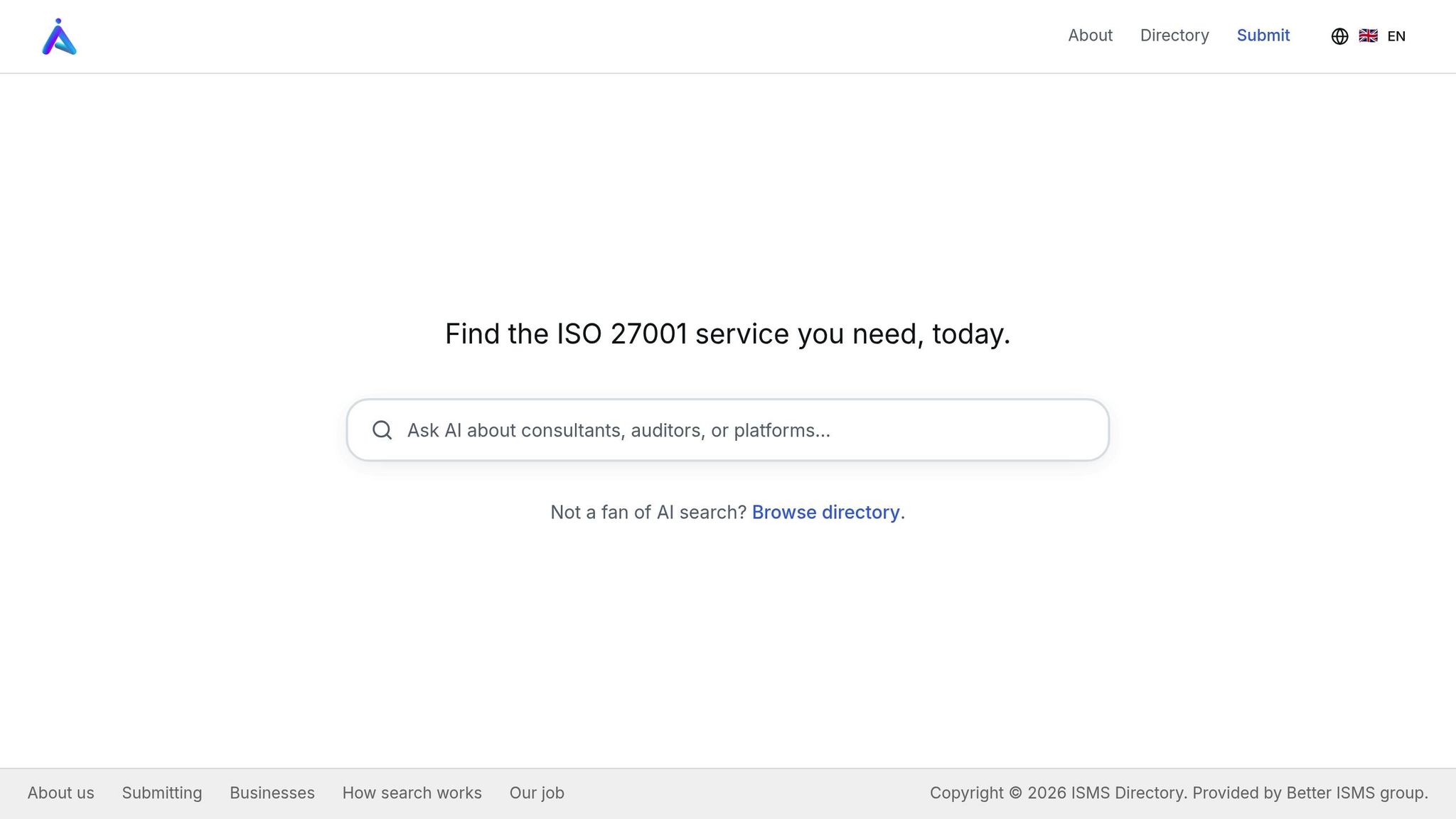
ISMS Directory Platform Overview
The ISMS Directory is your go-to platform for connecting with accredited certification bodies, consultants, and Managed Service Providers (MSPs) specializing in ISO 27001 compliance. Each provider profile includes key details like headquarters, areas of expertise, and services such as audits and ISO certification. This directory spans a variety of regions, including the United States, United Kingdom, Australia, New Zealand, Ireland, Norway, and Mauritius. It also features well-known organizations, such as Perry Johnson Registrars (PJR), a UKAS-accredited certification body with a global footprint.
"Accelerate your journey to ISO 27001 and beyond with help from trusted partners. From implementation to audits, they offer hands-on support." - ISMS.online
This sets the foundation for a straightforward and efficient search process.
Step-by-Step Search Process on ISMS Directory
To get started, filter your search by selecting "Certification Body." This ensures you’re focusing on organizations authorized to issue ISO 27001 certificates, rather than consultants or MSPs. Next, check the country tag on each provider’s profile to confirm they offer regional support. Working with local auditors can simplify logistics and help cut down on travel costs.
Look for profiles that explicitly list services like "Audits" and "ISO Certification" and display accreditation markers such as UKAS or ANAB. Once you've narrowed down your list, use the "Contact" or "Website" buttons to reach out for quotes or to confirm their industry expertise.
Mistakes to Avoid When Choosing a Certification Body
Working with Non-Accredited Bodies
Opting for a non-accredited certification body can be an expensive misstep. Accreditation ensures that a certification body meets the ISO/IEC 17021 standards for impartiality and competence, providing confidence in their processes and results. Without this validation, your certificate might be rejected by government agencies or large corporations during procurement processes, as many require certificates from accredited bodies.
"Far too many businesses get certified by bodies that are not UKAS accredited. They then find that their certification is not accepted when bidding for work. Don't fall into this trap – it often seems cheaper on the face of it but it's a false economy."
– Colin Bracewell, ISOQAR
Additionally, certificates from non-accredited bodies lack recognition by the International Accreditation Forum (IAF), which can cause international partners to question their legitimacy. Beware of certification bodies offering unusually low prices, such as 52 AUD (approximately $35 USD), as these often indicate poor-quality audits. To avoid these pitfalls, always confirm a certification body's accreditation through trusted directories like IAF CertSearch, UKAS CertCheck, or the ANAB directory.
It's equally important to ensure that auditors have the expertise relevant to your industry.
Ignoring Industry-Specific Knowledge
Choosing auditors without experience in your sector can waste time and reduce the practical benefits of your certification. Auditors unfamiliar with your industry may spend excessive time trying to understand your operations, leaving little room for meaningful security insights. This often results in generic findings that fail to address the unique risks faced by organizations in specialized fields like healthcare, finance, or cloud services.
When auditors lack industry knowledge, you may also need to spend considerable time explaining your business processes, which can detract from the audit's overall value. To avoid this, request CVs for the auditors assigned to your project during the proposal stage and ask for references from companies they've previously worked with. Additionally, confirm that the certification body is authorized to certify businesses in your specific industry by checking directories like UKAS or ANAB.
While expertise is crucial, cost considerations also need careful evaluation.
Making Decisions Based Only on Price
Choosing a certification body based solely on the lowest price can lead to subpar results. Low-cost providers often lack accreditation, conduct superficial audits that fail to identify critical security issues, and may tack on hidden fees for travel, management, or mandatory subscriptions. Initial quotes might exclude costs for essential services like surveillance audits, certificate printing, or rescheduling.
"Focusing only on the lowest quote often bypasses accreditation checks, auditor expertise, and hidden costs. Underqualified bodies may conduct cursory audits that leave critical gaps, undermining your security posture."
– Acato
Instead of focusing solely on price, evaluate proposals based on accreditation status, auditor qualifications, and industry expertise. Compare offerings from two or three accredited bodies, paying attention to their audit methodologies and fee structures. This approach ensures you receive comprehensive and reliable service. For reference, accredited audits for smaller companies typically cost around $12,000, while third-party consultants generally charge daily rates starting at approximately $1,800.
Conclusion
When selecting an ISO 27001 certification body, focus on accreditation, industry expertise, and reputation. Accreditation from organizations like ANAB ensures your certification holds global credibility. Without it, your certificate might be dismissed during procurement evaluations.
It's also essential to choose auditors who understand the specific challenges of your industry. Whether you're in finance, healthcare, or cloud services, auditors familiar with your sector's regulatory requirements and risks can provide more meaningful insights.
"Most ISO 27001 audit failures aren't about bad security. They are about misaligned auditors." – Gowsika, Sprinto
To streamline your search, tools like ISMS Directory can be a game-changer. It consolidates accredited certification bodies, allowing you to verify accreditation, filter by industry focus and location, and read client reviews - all in one place, sparing you the hassle of navigating multiple websites.
For the best results, request proposals from at least two or three accredited bodies. Compare their auditor qualifications, audit methodologies, and costs - not just their pricing. Keep in mind that ISO 27001 certifications are valid for three years and require annual surveillance audits.
FAQs
Why is it important to choose an accredited ISO 27001 certification body?
When choosing an ISO 27001 certification body, accreditation plays a crucial role. It ensures the certification body adheres to internationally accepted standards for competence, impartiality, and reliability. Accredited bodies operate under the ISO/IEC 17021 framework, which ensures that audits and certifications are conducted with the highest levels of professionalism and integrity.
In the United States, it's wise to select certification bodies accredited by respected organizations like ANAB (ANSI National Accreditation Board). This adds credibility to your certification, ensures global recognition, and demonstrates your commitment to robust information security practices. On the other hand, working with non-accredited bodies can be risky - they often lack the stringent oversight required, potentially diminishing the value and trustworthiness of your certification.
How do I confirm if a certification body is properly accredited?
To verify whether a certification body is properly accredited, look for recognition from a reputable accreditation body like ANAB (ANSI National Accreditation Board). ANAB assesses certification bodies to ensure they meet international standards, such as ISO/IEC 17021. You can check the accreditation body’s website for a list of accredited organizations or reach out to them directly for confirmation.
Accreditation ensures that your ISO 27001 certification carries weight and aligns with globally accepted standards.
What factors should I consider when estimating the cost of ISO 27001 certification?
When calculating the cost of ISO 27001 certification, several factors come into play. One of the biggest considerations is the scope and complexity of your Information Security Management System (ISMS). If your ISMS covers multiple locations, systems, or processes, the effort and resources required will naturally increase, which drives up costs.
Another critical factor is the certification body you select. It's best to go with an accredited organization, such as one recognized by ANAB. While these providers might seem more expensive upfront, they ensure credibility and help you avoid potential issues (and costs) that could arise from using non-accredited bodies. Beyond this, the size of your organization, the industry you operate in, and how developed your current security measures are will all influence the final price. On average, certification costs can range anywhere from $25,000 to $250,000.
Finally, remember to budget for ongoing expenses. These include surveillance audits, maintenance, and re-certification, all of which are necessary to keep your certification valid and maintain compliance over time.