
Internal vs. External Audits: Role in Certification Roadmap
Achieving ISO 27001 certification hinges on two types of audits: internal and external. Internal audits help identify and fix gaps in your Information Security Management System (ISMS) before external audits. External audits, conducted by independent bodies, verify compliance with ISO 27001 standards and are required for certification. Here's a quick breakdown:
- Internal Audits: Conducted by your team or consultants to evaluate ISMS effectiveness and address issues early.
- External Audits: Performed by accredited third parties to confirm ISO 27001 compliance and grant certification.
Both audits are essential for building a secure and compliant ISMS, ensuring readiness for certification, and maintaining trust with stakeholders.
ISO 27001 Internal Audit Essentials: Everything You Need to Know
sbb-itb-b92d866
Key Differences Between Internal and External Audits
Internal vs External Audits: Key Differences for ISO 27001 Certification
Grasping the distinctions between internal and external audits is essential for planning your ISO 27001 certification journey.
Purpose and Objectives
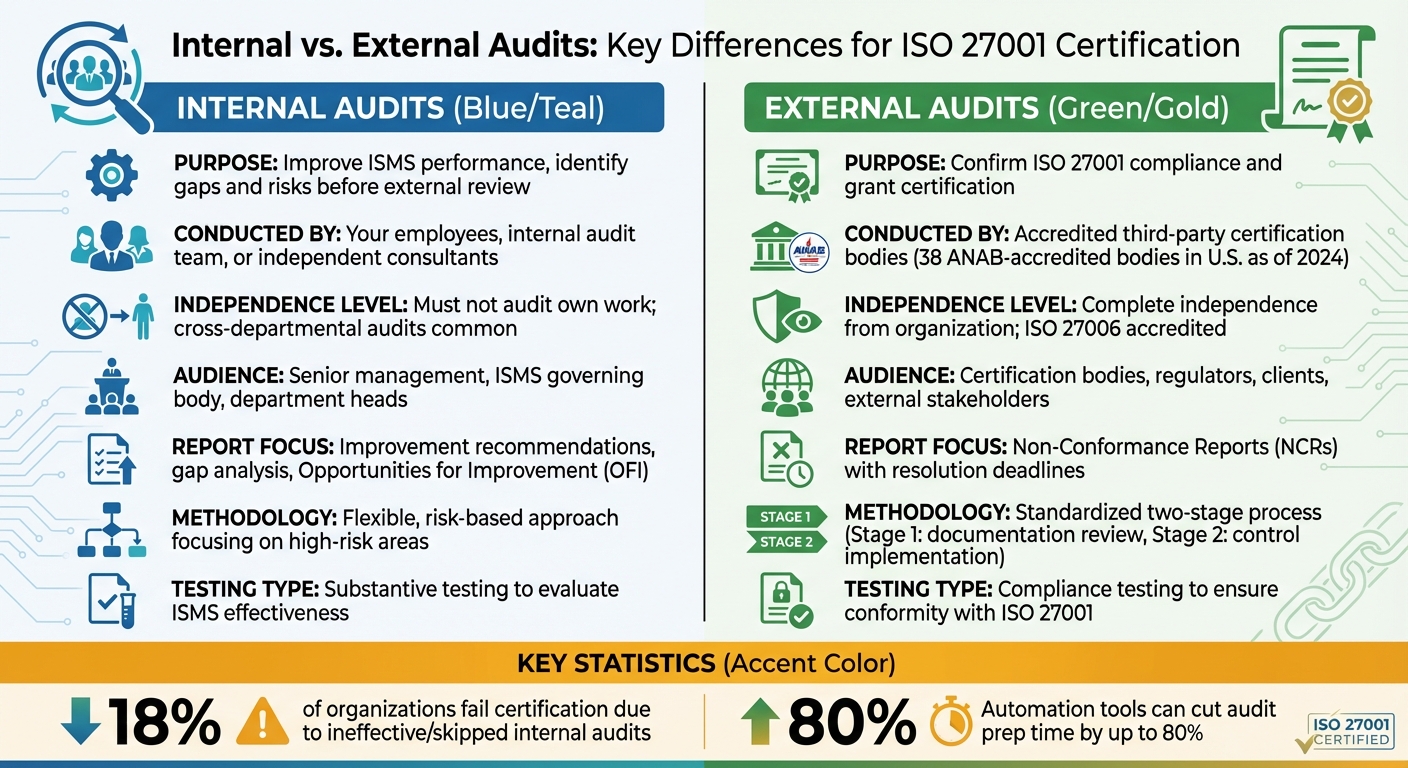
The goals of internal and external audits are fundamentally different. Internal audits focus on improving the performance of your Information Security Management System (ISMS). They help identify gaps, risks, and areas for improvement before external audits take place. On the other hand, external audits aim to confirm compliance with ISO 27001 standards. These are conducted by accredited certification bodies to verify that your ISMS meets all necessary requirements and to determine if you qualify for official certification.
Dave Mahoney from Pivot Point Security explains it well:
"The ISMS internal audit is about management validating the effectiveness of the ISMS whereas the certification audit is about the auditor validating that your ISMS is compliant with the standard."
This difference shapes how each type of audit is approached. Internal audits rely on substantive testing to evaluate ISMS effectiveness, while external audits use compliance testing to ensure conformity with ISO 27001. Internal audit reports are typically directed to management and the board, while external audit reports are intended to reassure stakeholders like customers, investors, and regulators.
Independence and Authority
The independence of the auditor plays a critical role in ensuring objectivity. Internal audits can be carried out by your employees, a dedicated internal audit team, or independent consultants. The important requirement here is that the auditor must not be directly involved in the processes or departments they are evaluating.
External audits, however, demand complete independence from your organization. These audits are conducted by accredited third-party certification bodies. For example, as of 2024, there are 38 ANAB-accredited ISO/IEC 27001 certification bodies operating in the U.S.. While internal auditors may have a deeper understanding of your organization, this familiarity can sometimes limit their objectivity. In contrast, external auditors bring a completely impartial perspective because they have no internal affiliations.
Scope and Methodology
Internal audits offer the flexibility to focus on high-risk areas within your organization. This risk-based approach allows you to allocate resources to areas where they can make the most impact.
External audits, however, follow a standardized two-stage process outlined by ISO 27001. Stage 1 checks your documentation and readiness, while Stage 2 evaluates how well your controls are implemented and functioning. Internal audits serve as a proactive tool to identify and address nonconformities ahead of external reviews. This not only reduces the risk of failing certification but also demonstrates the ongoing improvement required by ISO 27001's Clause 10. By understanding and leveraging these methodological differences, you can use internal audits to smooth the path for external certification.
How Audits Fit Into the Certification Timeline
Scheduling audits strategically ensures that internal and external evaluations align smoothly with your certification plan. For most organizations, the ISO 27001 certification process takes 12–18 months, though smaller, well-prepared teams might finish in just 3–10 months. The trick is to balance preparation with enough time for thorough verification.
Internal Audit Schedule
Plan your internal audit for around 9–10 months into the certification process. This step gives you the chance to fully implement your ISMS, collect evidence, and address any weak points before the external review. Think of it as your chance to rehearse. As TheHGTech Security Team explains:
"The internal audit is your dress rehearsal. Find problems now when you can fix them, not when the certification auditor documents them."
After completing the internal audit, a management review should follow - typically around month 10. This review ensures leadership is actively involved and that resources are allocated to address any issues. Skipping or rushing this phase can have serious consequences; organizations that do so often fail Stage 2 because they miss the opportunity to resolve problems privately. In fact, about 18% of organizations fail certification due to ineffective or skipped internal audits. Once the internal audit is complete, the focus shifts to the external audit stages.
External Audit Milestones
The external audit process is divided into two stages.
- Stage 1: This is a documentation review, covering policies, the Statement of Applicability, and your risk assessment. It typically lasts 1–2 days and should be scheduled around month 11, after addressing findings from the internal audit.
- Stage 2: This stage evaluates whether your controls are functioning as described. For medium-sized organizations, this audit usually takes 3–5 days, but for larger enterprises, it can stretch to 12+ days. To be ready for Stage 2, your ISMS should have been operational for at least three months, providing enough evidence to demonstrate compliance. Schedule Stage 2 about 4–6 weeks after Stage 1 to allow time to resolve any documentation issues identified during the initial review.
After achieving certification, the process doesn’t end. You’ll need to undergo annual surveillance audits in the first and second years, followed by a full recertification audit every three years. To avoid any certification gaps, plan your recertification audit 3–4 months before the certification expires.
Using Internal Audit Results to Prepare for External Audits
Strategic internal audits can make external reviews far more manageable. When done right, they provide a clear path for improvement, turning what might feel unpredictable into a structured and efficient process.
Start by categorizing your findings based on severity. Major non-conformities - like the absence of a formal internal audit process - can seriously jeopardize your certification efforts. On the other hand, minor issues, such as an employee missing a specific training, need correction but won’t derail the process entirely. Observations and improvement opportunities, while not critical for certification, still highlight areas worth addressing. By organizing findings this way, you'll have a solid foundation for deeper analysis.
The next step is to dig into the root causes of each issue. External auditors don’t just want to see that you’ve identified problems - they want to know you’ve addressed the underlying causes. For example, if access control policies fail, ask yourself: Was the policy unclear? Was training inadequate? Or was there a lack of accountability? Document these causes thoroughly, assign ownership, and set realistic deadlines for resolution. This shows both diligence and readiness.
Evidence organization is another key component. Collect timestamped evidence - such as logs, screenshots, approval records, and interview notes - and centralize it well before the external audit begins. Tools that automate evidence gathering can save significant time, cutting preparation efforts by up to 50% and overall audit prep time by as much as 80% [4, 28]. For additional help, platforms like ISMS Directory can connect you with expert internal audit providers and compliance resources. Once your evidence is in order, you can shift focus to preparing your team.
Use your internal audit findings to coach your team for the external review. Identify individuals who might struggle to articulate their roles or processes, and conduct mock interviews to build their confidence. As Rafia Rizwan puts it:
"Internal audits tell you what's wrong. Audit readiness is proving what's right".
When remediation efforts, documentation, and team training come together, the certification process becomes far more predictable and manageable.
Reporting and Communication Differences
When it comes to audits, reporting serves as the bridge between identifying issues and taking action. It also plays a key role in distinguishing internal efforts from external validation. Internal and external audit reports are crafted with different audiences and goals in mind, each addressing unique needs.
Internal Audit Reporting
Internal audit reports are all about improvement. They’re designed to help organizations tighten their processes and address vulnerabilities. These reports are typically shared with senior management, the ISMS governing body, and department heads - the very people who have the authority to make changes.
An internal audit report usually includes:
- An executive summary for a high-level overview.
- A detailed analysis of gaps or weaknesses.
- Recommendations for continuous improvement.
ISO 27001 Clause 9.2.2.c even mandates that internal audit results be reported to relevant management. Beyond formal findings, these reports often highlight Opportunities for Improvement (OFI), offering teams actionable steps to bolster their security posture before facing external scrutiny.
These internal reports stay within the organization and are used to guide decisions, allocate resources, and monitor corrective actions. They’re not about compliance for outsiders - they’re about making the organization stronger from within.
External Audit Reporting
External audit reports, on the other hand, are formal documents meant for certification bodies, regulators, and external stakeholders like clients. Their main focus? Non-Conformance Reports (NCRs) - specific issues that must be resolved within a set timeframe to secure or maintain certification.
As Pacific Certifications puts it:
"External audits provide an independent assurance that your organization is complying with the standards, increasing customer and stakeholder trust".
These reports are all about objectivity and compliance. Unlike internal reports, which aim to drive change internally, external reports serve as a third-party validation of your organization’s adherence to ISO 27001 standards. They’re designed to build trust and confirm that your processes meet the required benchmarks.
Maintaining Audit Independence and Compliance Standards
When navigating the certification process, maintaining audit independence is absolutely essential for compliance. Under ISO 27001, this isn't just a recommendation - it's a requirement. Clause 9.2 specifies that internal audits must occur at planned intervals, while Annex A.18.2.1 emphasizes the need for independent reviews of an organization's information security measures. Without independence, your certification could be at risk. This standard applies equally to both internal and external audits.
One of the core rules here is simple: auditors should never review their own work. For instance, if an IT team member designs a security control, they shouldn't be the one testing or auditing it. To maintain objectivity, cross-departmental audits are a common practice - HR might audit IT, and finance could review operations. In smaller organizations, where staff resources are limited, hiring an independent third-party consultant to handle internal audits can solve the problem. Not only does this remove potential bias, but it also brings in expertise that smaller teams might lack.
External audits take independence a step further. Certification bodies must be accredited, such as through the ANSI National Accreditation Board, and they must adhere to ISO 27006 to ensure impartiality. External auditors are completely independent from your organization. As Dave Mahoney from Pivot Point Security explains:
"The ISO 27001 certification audit is required to rely on the internal audit and management's review of the ISMS to ensure that the organization is maintaining an effective ISMS".
In other words, the quality of your internal audit process directly impacts the success of your external audit.
Before hiring an external auditor, confirm their accreditation. Certification from an unaccredited body might not hold weight with clients or regulators. External auditors are there to verify that your organization follows its own policies and meets ISO 27001 standards. Their independence ensures that your certification is credible and trustworthy.
Training plays a big role in maintaining audit independence. Internal auditors need formal training to identify nonconformities without bias, even when they're reviewing processes they're familiar with. Pairing this training with practices like auditor rotation and direct reporting to top management strengthens the framework. These steps not only meet ISO 27001's independence requirements but also create a seamless transition from internal reviews to external validation. Together, they set the stage for a successful certification process.
Conclusion
Internal and external audits play distinct yet complementary roles in your journey toward ISO 27001 certification. Internal audits act as a proactive checkup, helping you spot and address weaknesses before they become major hurdles during external certification. On the other hand, external audits provide the independent validation that stakeholders, clients, and regulators rely on to assess your security practices.
Think of internal audits as tools to measure how effectively your Information Security Management System (ISMS) supports your business goals and safeguards critical assets. External audits, meanwhile, confirm that your ISMS aligns with the specific requirements of the ISO 27001 standard. Together, they form a feedback loop that promotes continuous improvement and operational efficiency.
The financial implications are hard to ignore. By 2024, the global average cost of a data breach is projected to hit approximately $4.88 million. On top of that, research involving 143 U.S.-listed companies shows that ISO/IEC 27001 certification can boost profitability, labor productivity, and sales performance. Clearly, a well-structured audit framework isn't just about compliance - it directly influences your financial health.
Audits shouldn't be reduced to mere checklists. Use internal audit results to guide meaningful improvements, addressing gaps early to ensure a smoother external audit process. Prioritize root cause analysis over temporary fixes. This approach not only helps you secure certification but also builds a resilient security program that adapts and strengthens over time.
For expert guidance on simplifying your certification process, check out ISMS Directory. Their resources can support you at every stage of your ISO 27001 journey.
FAQs
Do we need an internal audit before the certification audit?
Yes, performing an internal audit before undergoing the certification audit is a smart move. It allows you to spot and fix any nonconformities, fine-tune your processes, and confirm that you meet the required standards. While it's not strictly mandatory, an internal audit can greatly improve your preparedness and boost your chances of passing the certification audit with ease.
How long should our ISMS run before Stage 2?
Your Information Security Management System (ISMS) should generally run for about 3 to 6 months before moving to Stage 2. This phase is crucial as it allows enough time to ensure the system is working effectively and meets all the necessary certification standards.
What happens if the external auditor finds major nonconformities?
If an external auditor uncovers major nonconformities, the organization risks having its certification suspended or even withdrawn. To avoid this, the organization must act quickly to address and correct these issues. Ignoring or delaying corrective actions could not only slow down the process but also put the certification entirely at risk.